
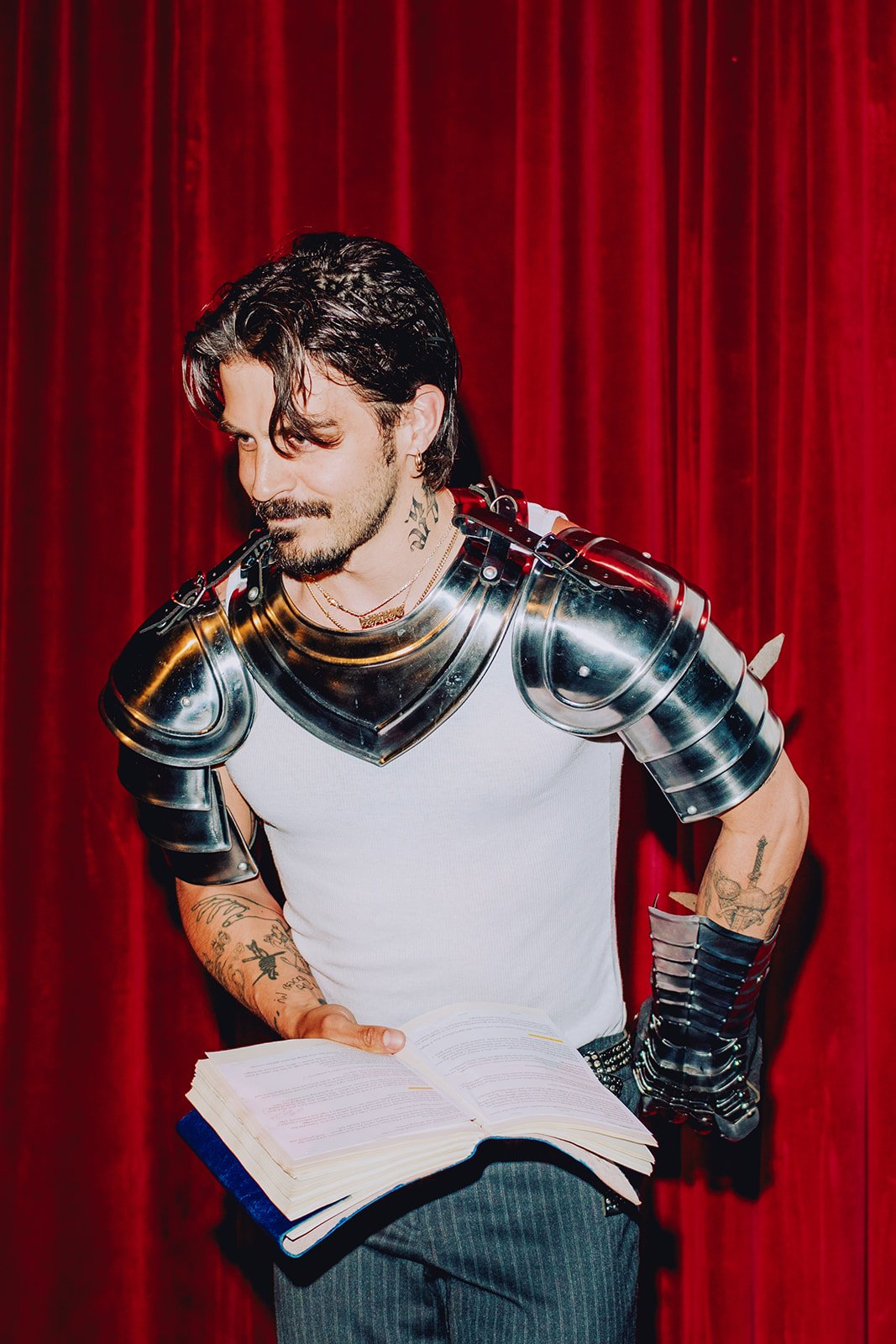
The work emerges from a fictional brand called CAM (Corporate Anthropomorphic Mascot), born from a parallel world known as CAMelot. This Camelot distorts the familiar Arthurian kingdom. Rather than embodying chivalry, honour, and heroic virtue, it is a surveillance state built around visibility, spectacle, and performance. At its centre is CAM, a mythical wolf whose castle functions as the kingdom’s panopticon, an all-seeing structure from which its subjects are watched and shaped.
Within Camelot, knights are expected to perform prescribed versions of themselves beneath CAM’s gaze. Their reflective armour becomes both costume and camouflage, projecting what the kingdom wants to see while concealing what exists underneath. Yet the knights are cunning. They perform obedience while finding covert ways to evade, deceive, and disappear from the all-seeing eye. Their resistance is rarely heroic in the traditional Arthurian sense; instead, it is slippery, playful, erotic, and opportunistic; small acts that preserve an interior life within a world demanding constant visibility.
Camelot becomes a mythological parallel to contemporary systems of surveillance, branding, and algorithmic self-presentation. Like the corporations and platforms that increasingly mediate daily life, CAM does not simply observe its subjects; it teaches them how to behave under observation. CAM exists simultaneously as ruler, mascot, corporation, and deity, its power sustained by the belief that its gaze is everywhere.
Across paintings, installations, prints, and performance, fragments of this alternate Camelot reveal subjects negotiating the tension between visibility and disappearance, performance and interiority. By corrupting a familiar mythology, CAM uses fantasy as a distorted mirror of contemporary life, where surveillance is increasingly disguised as participation, connection, and visibility. Ultimately, the work asks what remains of the self when identity becomes a continuous performance for an unseen audience and whether slipping beyond the gaze, even momentarily, might offer a form of freedom.